
The Devourers Explores Myth, Morality, and Werewolves in India
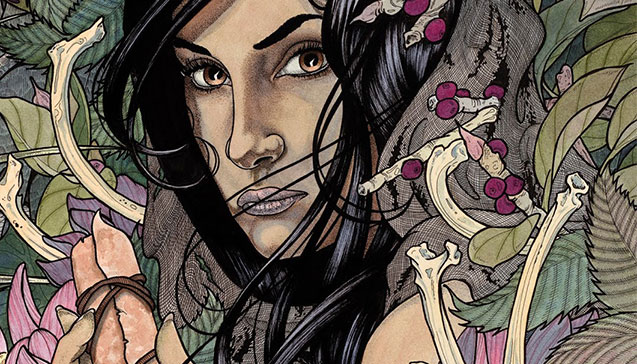 Beneath a full moon in Kolkata, a lonely, mild-mannered college professor sits across a table from a stranger with a story. Transfixed—almost intoxicated—the professor listens raptly to a charismatic young man’s unlikely confession: he’s a shape-shifter, a half-werewolf by a hundred other names. As the stranger without a true name weaves his tale, his words come to life, raw, visceral, dream-like, and, often, discomforting. Once the tale has paused (enticingly half-finished), Alok, the professor, jokes to the stranger that he might have inhaled too much smoke. “But I know whatever just happened wasn’t me getting a contact high,” he says. “I feel like I’ve just woken from the most vivid dream I’ve ever had.”
Reading The Devourers is a similar experience. Indra Das’s debut novel is a story about the nature of stories, the ever-blurred lines between fantasy and reality, good and evil, man and monster.
At the conclusion of their first meeting, the stranger offers Alok a job transcribing and translating two texts that together detail a centuries-old saga that eventually envelops and overwhelms the initially skeptic professor. The three stories—both collections of tales, as well as the narrative from present-day India—culminate in an unexpected examination of myth, morality, identity, and the erratic, undefinable nature of love.
The texts take us back to the 17th century, to the India of the Mughal Empire and beyond, as we follow the actions of a trio of shape-shifters. Across continents, there are stories of their kind, and of the differing tribes that compose them. Some call these creatures werewolves, others djinn, and still others have no name for them, living in their imaginations only as something to be feared. These non-human beings diverge in many ways, though each consumes humans to survive and to serve as a suitable “first self” identity.
Given to Alok, however, is specifically a story of Fenrir, his two companions, and the human woman who changed them forever. But this is no love story: it is a gruesome tale of Fenrir’s quest to reclaim a measure of humanity, and those he hurts along the way. It is also a tale of Cyrrah, the woman plunged into a startling world she knew nothing about. And, of course, it is a story about the stranger, though the nature of his involvement remains opaque until the novel churns to its final moments.
Immersing ourselves in the past, we discover how Fenrir came to love—in the way he is capable—Cyrrah, a prostitute, and of how he raped and impregnated her in the hopes he could create life as well as take it. It is in that moment that the story switches (quite literally, as Alok switches scrolls). From there, Cyrrah’s voice carries the day. Though she does seek vengeance,exactly, she does desire a reckoning, as she grapples with how she feels about the child growing within her. Her chapters are a moving look at trauma, heightened by the gory supernatural repercussions of her abuse.
An interesting concept emerging in this thread of the narrative is the tenuous nature of morality. Fenrir’s other self, the bloodthirsty creature that lurks beneath his agreeable exterior, is less monstrous than his warped, human sense of honor and love, both cloaked in hubris and lacking empathy. His rape of Cyrrah not only harms her, but alienates him from his cohorts, who consider toying with his prey and leaving her to live with her dishonor.
“There is a difference between cruelty and killing,” the stranger tells Alok. “You, I’ve seen, don’t much separate the two. I don’t think a wolf killing a lamb exercises cruelty.”
Indra Das meditates on that statement for much of these 300 pages, in language that is otherworldly and ethereal even when recounting horrific events. It is a novel that revels in the beauty of the grotesque in a form that will be recognizable to, and appreciated by, fans of Neil Gaiman and China Miéville. For a shape-shifter, to consume is to become. What you devour, you absorb into yourself. Reading The Devourers is a lot like that; it will stay with you long after you’re finished with it.